
8.1.6Which method should I use?
Disk and Washer Problems
The region at right is bounded by the
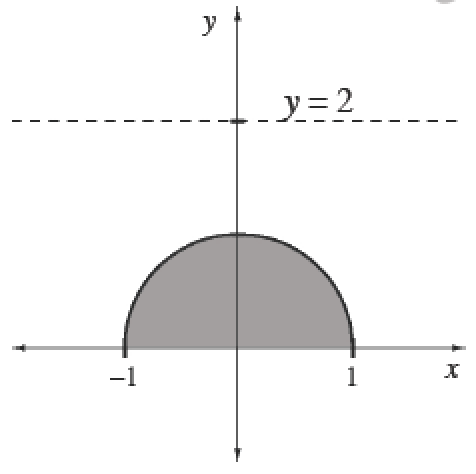
When each shaded region below is rotated about the given axis, decide if it is best to slice the resulting solid horizontally or vertically in order to calculate the volume. Describe the shape of each slice. Also indicate if the slices will have thickness
Rotated about the
-axis.

Rotated about the line
.
.png)
Rotated about the
-axis.
.png)
Rotated about the line
.

Using her excellent analytical skills, she has found that the volume can be generated by rotating a region bounded by the y-axis and the curve
Calculate the volume of the vase. Include a diagram with a typical slice. What quantity represents the thickness of the slice?
Using your results, determine the dimensions for the cylindrical tube that she wants to construct.
GEOMETRY PROOF: VOLUME OF A CONE
A previous geometry class introduced a formula often used to calculate the volume of a cone. However, an integral can also be used to calculate the volume of a cone. In order to apply calculus, view a cone as a right triangle revolved about the
If the cone has height
and base radius , write an equation for the line that will form the triangle. (Hint: The -intercept is and -intercept is .) Set up an integral that will accumulate the volume of the disks.
Evaluate your integral from part (b). Remember that
and are constants. Did you get ?
.png)

Suppose the region in problem 8-56 is revolved around the line

THE MATRYOSHKA DOLL
For generations, special wooden nesting dolls called matryoska have been handcrafted in Russia. This type of cylindrical doll opens at the midsection and nested inside is a smaller wooden doll (with the same shape) which itself opens to another doll. Some matryoshka are made up of ten or more dolls! The smallest doll, often less than a centimeter tall, is solid wood.
Explain why, under ideal conditions, the sum of the volumes of the nested wooden shells of the different-sized dolls will calculate the full volume of the interior of the largest doll. Homework Help ✎
.png)
Instead of using an area formula, Joshua wants to use calculus to find the area of a circle. He realizes that one way to shade a circle is to draw thin concentric circles from the center out, so close together that they entirely cover the circle.
To calculate the area, he needs to add up the area covered by each “circumference” of these circles. If the radius starts at a value of
.png)

Accumulating Area and Volume With Integrals
Riemann sums helped add the areas of sequential rectangles to determine an approximate total area of a region. By taking the limit as the number of rectangles approaches infinity, we get an accurate measure of area.
Likewise, if we add sequential volumes of disks or other slices, we obtain an approximate total volume of a given solid. By taking the limit as the number of slices approaches infinity, we get the exact volume.
We can skip the limiting process if we think of “infinitely thin” rectangles or slices from the start. For example, in problem 8-61, Joshua added “infinitely thin circumferences” with an integral to determine the area.
If the area of an infinitely thin slice of a solid at an arbitrary
GEOMETRY PROOF: VOLUME OF A SPHERE
Another way to view a sphere is as a semicircle rotated about an axis. Use a generic semicircle such as
The diagram at right shows the region bounded by the
Describe a method you can use to determine the volume of the solid.
Set up and evaluate the integrals needed to calculate the volume. (Using washers, the solution will require two integrals.)
.png)
At which point(s) on the graph of
and are both positive and are both negative is positive and is negative is negative and is positive
.png)


